
Each year, the Breakthrough Challenge highlights bold ideas that could change how care is delivered at Women’s College Hospital. Teams from across the hospital pitch ideas to improve care for women and equity-deserving communities, with projects spanning clinical care, trauma-informed care, research, quality improvement and education. This transformative challenge first launched in 2023 with the legacy of Karen Green, who left a gift to the Foundation to carry on her legacy championing innovation in women’s health.
This year’s winning project, AI and Us by Vanessa Wright, tackles one of the most fast-moving challenges in healthcare currently: how patients are using artificial intelligence (AI), and what hospitals should do about it.
Rather than building a new AI tool, the project creates a space within Women’s College Hospital’s WE Learn Hub where patients, caregivers and clinicians can share how they use AI in their everyday health decisions and co-design the resources and guidance that come next. The idea grew out of conversations that Vanessa kept hearing among colleagues. “Providers were referring to AI as the third person in the exam room, that white elephant that no one had invited, and I thought, we need to invite AI in, and talk about it, together.”
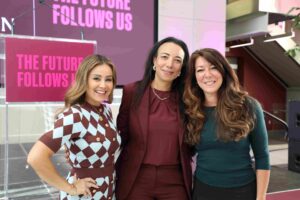
Right to left: Vanessa Wright, Sandra Sualim (CEO of Women’s College Hospital Foundation) and Melissa Grelo (TV personality & host), pictured at Women’s College Hospital’s 2026 Breakthrough Challenge
Meeting patients where they already are
Many patients now turn to AI to understand a symptom or a diagnosis before they speak to their healthcare provider. Vanessa acknowledges this as an act of autonomy rather than a problem to be managed. “Patients are already making informed choices about their own health, and using AI is part of how people exercise that autonomy,” she says. “This project starts from that.”
AI and Us uses this technology to ensure that care is equitable and patient centric. “It’s about naming the imbalances of power between institutions and patients,” she says, “and recognizing that we have some answers, but they have more.”
This approach is rooted in Vanessa’s role as a nurse practitioner with refugee patients at Women’s College Hospital’s Crossroads Refugee Clinic and her program of research as an Associate Scientist. Her work builds from a recognition that health goes beyond medical concerns. It includes education, food, housing, and employment, and patients are likely using AI to navigate all of it. “I witnessed hundreds of patients trying to navigate the system in isolation,” she says. “You can’t get away from how that shapes your approach to accessible, collaborative care.” She points out that AI and Us aims to bring that largely unspoken piece into the open, so patients and their care teams can explore it together.
Designing for real patient’s needs & grounded in equity
The project will recruit a diverse patient and caregiver advisory group and workshop participants who reflect the hospital’s communities and hold a range of views on AI, from enthusiastic to deeply wary. Providers from across the hospital will take part as well, and there will be multiple ways to participate.
Three principles guide the work: relevance, responsiveness and equity.
While some may worry that digital tools put more space between patients and providers. Vanessa disagrees. She describes the WE Learn Hub as the hospital’s “digital front door,” an open platform, with no password required, where people can reach Women’s College from wherever they are and guide their own learning.
Through AI and Us, patients will be able to document how they use AI: what tools they turn to, what they look up, and how it shapes daily decisions about their health. That gives clinicians a rare view into what happens between visits. In the longer term, she hopes the project will produce patient-informed recommendations on AI in ambulatory care that could reach policymakers.
What comes next
Winning the Breakthrough Challenge marks the beginning of a year of growth for AI and Us. The $100,000 award will carry the project through its first 12 months, which will allow Vanessa and her team to create the advisory group, run two co-design workshops and, finally, launch a pilot platform within the WE Learn Hub. The key accelerator is that the project isn’t starting from scratch. The WE Learn Hub, now entering its second phase, already has secure content management, vetted privacy and data governance policies, an integrated learning management system, and a dedicated team and vendor.
“It’s like building a third floor on a house when the first two floors are already built,” Vanessa says. That foundation means the funding can go toward designing a platform patients will actually use, rather than building infrastructure.
In addition to the existing infrastructure, Vanessa believes Women’s College Hospital is uniquely positioned to lead this work. As an ambulatory care hospital, it offers specialist care while remaining deeply community-oriented, so both hospitals and community health sites can see themselves in it.
“It’s not really about what happens inside our hospital so much as what happens outside of it,” she says. That outside view matters, because most institutions are still catching up. “Patients’ use of AI is widespread, but most institutions haven’t worked out how to engage with it,” Vanessa says.
AI and Us is designed to offer another way. “The model of co-design and continuous patient feedback and governance is really built to be shared,” she says. Other organizations will be able to adapt how the platform handles policy, privacy and long-term upkeep.
“
This opportunity is like none other, cultivating ideas with an amazing team and sharing them with people who care.” Vanessa is deeply grateful to the legacy of Karen Green’s and the foundation for curating and hosting such a remarkable event, with big impact and scale. “The ideas shared at the Breakthrough Challenge were cataclysmic… and opportunities just like this allow us to take them to the next level.” No matter how fast technology shifts around us. It is through relationships and honoring peoples lived realities that we must continue to center our care.