For decades, skin conditions in people with deeper skin tones have been diagnosed later or missed entirely because the visual signs clinicians are trained to recognize, such as redness, can be harder to detect.
This summer, an innovative diagnostic technology designed to close that gap is being used for the first time in an Ontario hospital, thanks to generous donor support through the 2025 Women’s College Hospital Breakthrough Challenge, a research competition that funds bold ideas with the potential to transform healthcare.
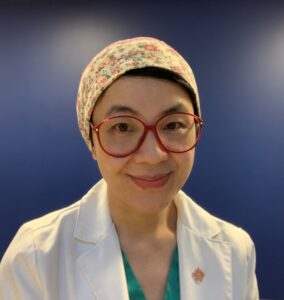
When Dr. Sheila Wang presented her winning project at last year’s Breakthrough Challenge, she described it as ‘seeing the unseen.’ That idea has shaped much of her career: asking what happens when the tools healthcare providers rely on do not work equally for everyone.
Dr. Wang is a dermatologist and Clinician Investigator at Women’s College Hospital, an Assistant Professor at the University of Toronto and co-founder of Swift Medical, an innovative wound imaging platform used by more than 1 million patients each year. Her work has earned national recognition including the Governor General’s Innovation Award and the Canadian Medical Association Young Leader Award. Yet, she is quick to point out that “innovation is a team sport.”
Her Breakthrough Challenge-winning project, Seeing the Unseen, combines artificial intelligence with spectral imaging to make inflammation and itch visible, even when those signs are not easily seen on the skin. The goal is to support more accurate diagnoses, especially for people with deeper skin tones.
“For patients with deeper skin tones, inflammation can look very different,” says Dr. Wang. “By using this imaging we’re creating a very objective visual map of inflammation, which improves diagnostic confidence and makes patients with deeper skin tones feel like their skin is being recognized and they’re being taken seriously.”
This summer, patients seeing Dr. Wang at Women’s College Hospital’s RKS Dermatology Centre have the opportunity to participate in a study evaluating this new approach. It is the first time this technology has been used in an Ontario hospital, marking an important step toward more equitable dermatology care.
Supported by donor generosity, Dr. Wang and her team are helping shape a future where every person receives the accurate diagnosis they deserve, regardless of their skin tone.
Donate Now
Make a donation to support equitable and compassionate care at Women’s College Hospital.
What We Do
Women’s College Hospital is revolutionizing healthcare for a healthier, more equitable world.