
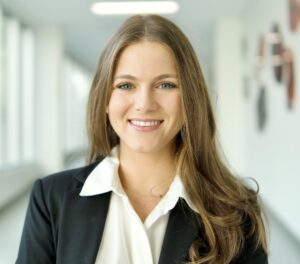
For Physicians’ Day, we sat down with Dr. Romy Segall, an Internal Medicine resident at Womens College Hospital (WCH), to learn more about her journey from Dalhousie medical school to training at WCH, and the values that continue to shape her experience. Dr. Segall reflects on learning in an environment grounded in equity and innovation, her experience in the hospital’s unique Acute Ambulatory Care Unit and how mentorship at Women’s College Hospital is helping shape the physician and leader she is becoming.
Can you tell us a little about your career as a physician so far and what drew you to internal medicine?
I completed medical school at Dalhousie University and moved to Toronto for Internal Medicine training at the University of Toronto. I am currently an Internal Medicine resident at Women’s College Hospital. This July, I will begin a Chief Medical Resident (CMR) year at Toronto Western Hospital, with plans to apply for the Critical Care fellowship in the fall.
During medical school, I was drawn to Internal Medicine for its breadth, complexity and the opportunity to care for patients with multi-system disease. It’s a field that allows for both deep clinical reasoning and meaningful relationships with patients. Supporting people through their most vulnerable moments has been one of the most rewarding aspects of my training and continues to reinforce my commitment.
I’ve also been inspired by my mentors to pursue a career as a clinician-educator, with a focus on combining patient care with teaching and mentorship.
Physicians’ Day honours Dr. Emily Stowe, a trailblazer who fought to practice medicine in Canada at a time when women were excluded from the profession. More than 140 years later, WCH continues to champion equitable, accessible care for women and marginalized communities. In your work as a resident, where do you see that mission showing up most clearly?
In my work as a resident, I see this mission most clearly in the everyday effort to provide equitable care to patients facing structural barriers, whether related to gender, socioeconomic status, language, or access to care.
This often shows up in small but meaningful ways, such as advocating for patients who may not feel heard, ensuring care plans are culturally and socially appropriate, and working within interdisciplinary teams to address gaps beyond strictly medical needs.
It’s also reflected in the learning environment through conversations about bias, representation, and inclusive care. These experiences highlight that advancing equity isn’t just a system-level goal, but something we actively practice at the bedside every day!
You recently completed a rotation in the Acute Ambulatory Care Unit (AACU), a model of care unique to WCH. What stood out to you most about this experience?
My experience in the AACU highlighted how effective well-designed ambulatory care can be in delivering timely, patient-centred medicine. The unit allows us to assess and manage complex internal medicine conditions in an outpatient setting, often preventing unnecessary admissions while still maintaining a high level of clinical acuity and follow-up.
What stood out to me was the emphasis on accessibility and continuity. Patients are seen quickly, investigations are coordinated efficiently, and there is a strong focus on ensuring safe transitions back to the community. It creates a space where we can practice thoughtful, resource-conscious medicine without compromising quality.
I think what sets WCH apart is its commitment to reimagining care delivery, meeting patients where they are and designing systems that are both responsive and equitable. The AACU is a great example of how innovation in ambulatory care can improve both patient experience and health system sustainability.
Next year you’ll step into a Chief Resident role. As you reflect on your training at WCH, how has this environment shaped the kind of physician and leader you are becoming?
My training at WCH has had a profound impact on the kind of physician and leader I’m becoming. It’s an environment that emphasizes not only clinical excellence but also collaboration, humility, and advocacy. Working alongside multidisciplinary teams has reinforced the importance of listening to patients, colleagues, and learners, and recognizing that strong leadership is often grounded in creating space for others to contribute.
I’ve also been shaped by mentors who lead with empathy and intentionality, whether in patient care, education, or systems-level work. Their example has influenced how I approach challenges, communicate with teams, and support peers.
As I step into the Chief Medical Resident role, I hope to build on these experiences by fostering an inclusive, supportive learning environment, advocating for resident needs, and contributing to a culture that values both excellence and well-being.
The Foundation supports the research, innovation and programs that make WCH’s mission possible, helping carry Dr. Emily Stowe’s vision into the future. From your perspective as a resident, why does philanthropic support matter?
From a resident perspective, philanthropic support is something we see translated very directly into patient care and the training environment. It enables programs, clinics, and models of care, like the AACU, that might not otherwise exist within traditional funding structures, and it gives teams the flexibility to innovate and respond to patient needs in real time.
It also supports research and education, which shape how we practice not just today, but in the future. As trainees, we benefit from working in an environment that prioritizes curiosity, equity and continuous improvement, values that are often made possible through donor support!
Most importantly, that investment helps ensure care is more accessible, inclusive, and patient-centred, particularly for populations who have historically faced barriers. It’s a powerful way of carrying forward Dr. Stowe’s legacy, and it has a tangible impact on both the patients we serve and the physicians we are becoming.
Now that you’re reaching the end of your education, what advice would you give to a medical student or new resident considering a career in internal medicine?
I would encourage them to stay curious and keep an open mind early on. Internal Medicine is a broad field, and part of what makes it so rewarding is the ability to explore different paths before finding what fits best!
Focus on building strong fundamentals and clinical reasoning, but just as importantly, invest in your relationships with patients, peers, and mentors. Those connections will shape your experience and help guide your career decisions.
It’s also important to recognize that you don’t have to have everything figured out right away. Internal medicine offers flexibility, whether your interests evolve toward subspecialty care, research, education, or leadership.
Finally, take care of yourself along the way. It’s a demanding but deeply fulfilling field, and maintaining balance will help you sustain both your growth and your sense of purpose in medicine!
“From a resident perspective, philanthropic support is something we see translated very directly into patient care and the training environment.”